
Azhar Saeed
The history of biogas in Pakistan is long but fragmented. The country’s first biogas plant was established in Sindh in 1959, marking the beginning of what could have been a transformative shift in rural energy access. Over the following decades, however, the effort remained inconsistent. In 1974, the Pakistan Council for Appropriate Technologies (PCAT) helped install 21 additional plants, and the Directorate General of New and Renewable Energy Resources launched a national program aiming to install 4,000 biogas units by 1986. Subsequent initiatives followed, most notably the Biogas Support Program (BSP) in 2000, which targeted 10,000 units by 2006, and a Pakistan Dairy Development Company (PDDC) effort that added over 550 plants by 2009. The largest single push came from the Rural Support Program Network (RSPN), which invested Rs. 256 million in 2009 to construct 14,000 household units. Today, an estimated 5,000 small-scale biogas plants are operational across Punjab through collaborations with institutions such as the Pakistan Council of Renewable Energy Technologies (PCRET), PCAT, and the Pakistan Renewable Energy Society (PRES). Despite these various efforts, biogas development has remained a patchwork of isolated projects rather than a sustained national drive.
Meanwhile, across the border, India stayed the course. With sustained policy support, blending mandates, and robust public-private collaboration, India has built a thriving biogas ecosystem. Through the SATAT scheme (Sustainable Alternative Towards Affordable Transportation), India has mobilized over 2,200 projects, attracted investment from oil majors and cooperatives, and integrated biogas into urban waste management and rural development strategies. Cities like Mumbai are developing plants that process 1,000 tons of organic waste per day. In states like Uttar Pradesh and Gujarat, tens of thousands of rural households are transitioning from firewood to community-scale biogas.
Pakistan, by contrast, is still stuck at the pilot stage. Despite having over 60 million cows, and enormous volumes of urban organic waste, it has installed only around 5,000 domestic biogas units. Industrial-scale compressed biogas (CBG) production remains virtually nonexistent. Yet the numbers are compelling. If even 40% of Pakistan’s collectable cow dung were used, the country could produce more than 1.6 million tons of CBG annually, enough to meet its entire LPG demand, which currently costs the country over $300 million a year. If Lahore and Karachi alone processed just 1,000 tons of organic waste daily using modern co-digestion techniques, they could generate an additional 600,000 tons of CBG annually.
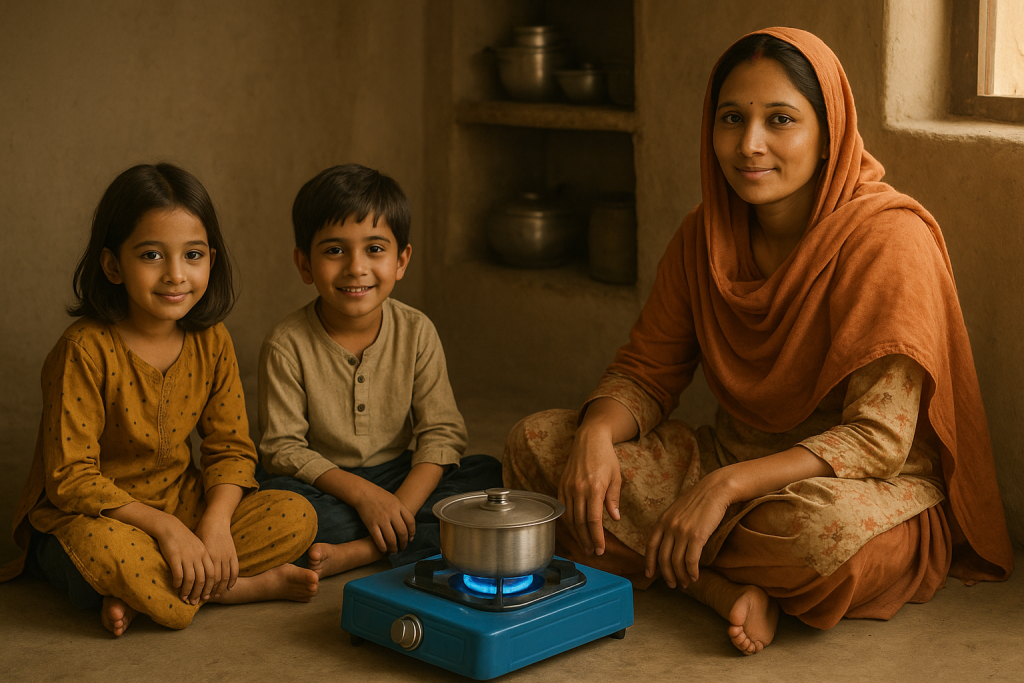
But the true promise of biogas is not in its macroeconomics, it lies in its potential to transform lives at the household level. Millions of rural and peri-urban families in Pakistan continue to rely on firewood, crop residue, and dung cakes for cooking. These fuels are inefficient, time consuming and hazardous. The task of collecting firewood or preparing dung cakes falls disproportionately on women and girls, limiting their time for education, paid work, or rest. Indoor air pollution caused by these fuels is a major contributor to respiratory diseases, particularly among children. Clean, affordable CBG can change that. Distributed through refillable cylinders or community pipelines, biogas offers a smokeless, efficient, and low-cost cooking fuel. If targeted toward households that currently use solid biomass, it could dramatically reduce the health burden of indoor pollution, free women from hours of unpaid labor, and allow children, especially girls, to return to school. For low income households that use LPG cylinders, a cheaper CBG alternative could provide immediate relief in the face of rising fuel costs.
The agricultural benefits are equally significant. The by-product of CBG generation, known as digestate, is a high-quality organic fertilizer. Unlike raw cow dung, which is poorly absorbed by soil and emits methane when left in the open, digestate is pathogen-free, more nutrient-rich, and improves soil structure. With rising prices of chemical fertilizers, this could offer farmers a local, low-cost alternative that boosts yields and regenerates degraded soils.
To turn this potential into reality, Pakistan needs a coordinated national effort. The government must take the lead by developing a national CBG policy under the Ministry of Climate Change or Energy, launching a biogas mission focused on off-grid households, and introducing blending mandates that require gas utilities and fuel distributors to incorporate a minimum percentage of CBG with LPG or CNG. Capital subsidies and tax incentives should be offered to CBG plant developers, especially in rural areas and under served towns, while biogas must be integrated into climate and agriculture strategies such as the National Adaptation Plan, the Green Stimulus Package, and the Kissan Card scheme.
Technical institutions must also rise to the occasion. Agricultural and engineering universities should lead applied research on feedstock treatment and ferric oxide-enhanced gas yield, develop training programs for plant operators and women led maintenance teams, and create design prototypes for affordable digesters and mini-refineries suited to local conditions. Technical training institutes like TEVTAs and NAVTTC should offer short courses on installation, safety, and appliance conversion, and certify local fabricators of CBG equipment.
The private sector and SMEs will be the engine of delivery. They should be incentivized to set up community-scale plants using locally sourced dung and food waste, manufacture gas-tight digesters and CBG stoves, and operate last-mile delivery networks in under-served areas. Existing LPG distributors can pivot to CBG, using their networks and logistics experience, while large agribusinesses and dairy cooperatives can build plants that serve both their energy needs and surrounding communities.
Biogas is not just a clean energy solution; it is a jobs engine too. A single community-scale plant can employ dozens of people in feedstock collection, operation, cylinder filling, digestate packaging, and appliance maintenance. Scaling to even 10,000 villages could create tens of thousands of green jobs, stimulate rural enterprise, and reduce migration pressures on cities. As demand grows for locally manufactured compressors, valves, gas meters, and piping, Pakistan’s SME sector will have new business opportunities and a chance to participate in the clean tech value chain.
For the millions of households still cooking in smoke-filled kitchens, biogas can be a lifesaver. For a country drowning in debt and fossil fuel dependency, it is a way to breathe easier, literally and economically. And for a region ravaged by climate change, deforestation, and rural poverty, it is a bridge to dignity, productivity, and clean energy sovereignty. Pakistan has all the ingredients: the feedstock, the unemployed youth, the struggling farmers, the health crisis, and the technology. What it needs now is the will to connect the dots.
