
Azhar Saeed
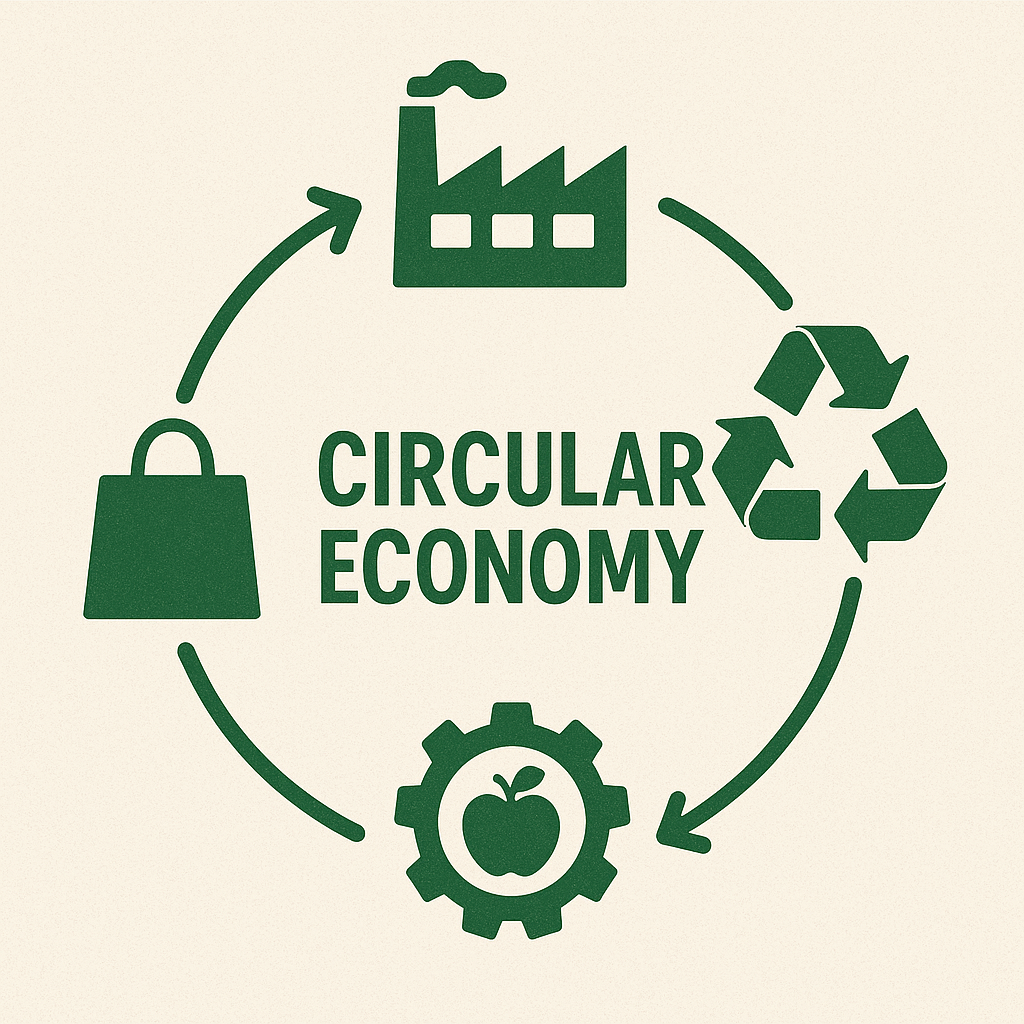
As climate change tightens its grip and natural resources grow scarcer, the world is awakening to a new economic logic; one that is not linear, extractive, and wasteful, but regenerative, inclusive, and efficient. This is the essence of the circular economy: an economic model that aims to eliminate waste and pollution, keep products and materials in use for as long as possible, and regenerate natural systems. Unlike the traditional “take-make-dispose” approach, the circular economy operates in loops – repair, reuse, recycle, and redesign – so that value is not lost but constantly recirculated.
For countries like Pakistan, where urban waste piles up faster than it can be managed, industrial inputs are increasingly imported, and environmental stress is intensifying, the circular economy is an economic imperative. This shift is not just about recycling more or banning plastic bags; it is about rethinking how we produce, consume, and grow. It offers a path to reduce emissions, create green jobs, cut import dependence, and unleash innovation across sectors.
Across the world, forward-looking businesses and governments are embracing circularity. In the Netherlands, Fairphone has developed a modular smartphone that allows users to replace individual parts, extending product life and dramatically reducing e-waste. In Sweden, ReTuna – the world’s first circular shopping mall – sells only repaired, upcycled, and second-hand goods, proving that resale and reuse can be mainstreamed. Much closer to home, in India, Graviky Labs has found a way to convert carbon emissions from vehicle exhausts into high-quality ink, turning pollution into a commercial resource.
These examples represent a larger global trend. Countries and cities are embedding circular practices into their industrial policies, innovation ecosystems, and climate strategies. Among developing economies, India offers particularly relevant lessons for Pakistan. Over the last few years, India has taken a deliberate and structured approach to mainstream circularity. Its national think tank, NITI Aayog, has published sector-specific roadmaps for textiles, construction, plastics, and electronics. Extended Producer Responsibility (EPR) rules now require companies to take responsibility for their plastic packaging, batteries, and e-waste. Startups like Banyan Nation and Recykal are using digital platforms to connect waste generators with recyclers, bringing transparency and traceability into previously opaque waste markets. Public procurement is being leveraged to create demand for circular products, and support is growing for innovation in green packaging, recycled textiles, and material recovery.
By comparison, Pakistan’s circular economy journey is still in its infancy. While there are encouraging signs – such as plastic bans in several provinces, or experiments in biogas and eco-packaging – these remain isolated and uncoordinated. Most of Pakistan’s recycling is still carried out informally, without safety standards or traceability. Formal EPR frameworks are missing. Policies that could advance circularity – on solid waste, urban development, or climate – remain fragmented. A few private sector actors are stepping up. Textile exporters like Sapphire and Artistic Milliners are embracing recycled cotton and water-saving processes. Packages Group is investing in recyclable packaging. GreenWep and other startups are experimenting with e-waste collection and processing. Yet these efforts are largely unsupported by regulation, financing, or scale.
The moment is ripe for Pakistan to act. The transition to a circular economy will not happen on its own. It requires a coherent national push that brings together policymakers, businesses, civil society, and development partners. First, Pakistan must articulate a clear vision for circularity. This means developing a national roadmap with measurable targets, sectoral priorities, and institutional responsibilities. Without strategic direction, pilots will remain pilots. Second, there is a pressing need to introduce Extended Producer Responsibility legislation – starting with plastics and electronics – to shift the burden of waste management onto those who produce and profit from it. EPR not only improves waste collection and recycling but also incentivizes better product design and reduced packaging.
A third priority must be to support circular enterprises, particularly startups and SMEs, through dedicated green funds, soft credit, and technical assistance. Without access to capital and enabling infrastructure, innovation will struggle to scale. The informal recycling sector, which forms the backbone of Pakistan’s material recovery, must also be integrated into formal systems. This requires investments in safety, training, and cooperative models, not displacement. Public procurement policies can further accelerate change by giving preference to recycled materials and circular products in government tenders and infrastructure projects. Finally, none of this will succeed without a cultural shift. The values of reuse, repair, and resource stewardship must be embedded in education systems, media narratives, and everyday consumer behavior.
Around the world, the race toward sustainability is accelerating, not just for climate reasons, but because circular models are proving more resilient, efficient, and competitive. If Pakistan continues on its current path of linear growth and resource extraction, it risks falling further behind economically, even as environmental and social costs mount. But if it seizes this moment to reimagine its economy – starting with waste, materials, and design – it can open up new pathways for green jobs, exports, and sustainable development. The future belongs to those who can do more with less and do it sustainably.
